
Legible Data at Planetary Scale: Understanding Our Environment

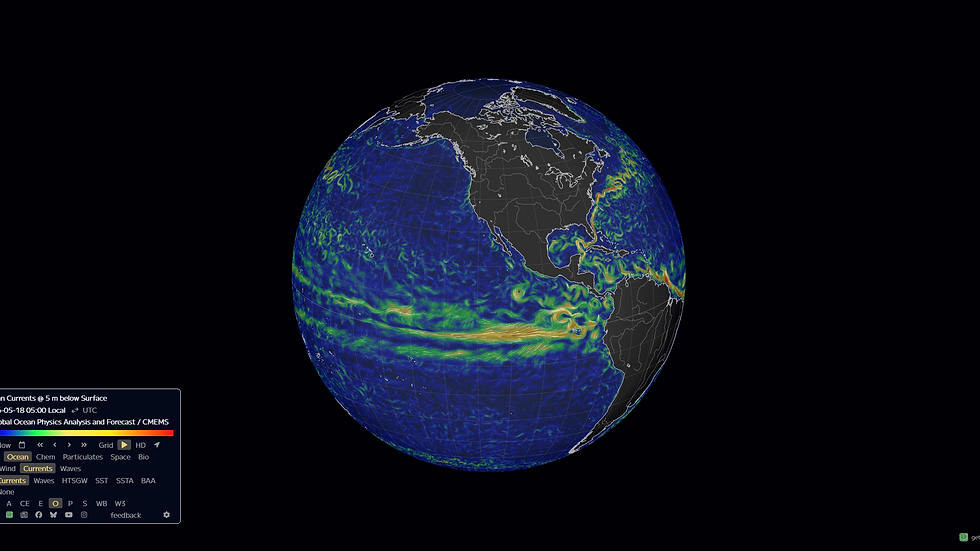
Every second, billions of environmental signals are generated across the Earth. The process of recording these signals has become tangible.
We can now track:
Ocean temperatures
Soil moisture levels
Wind patterns
Pollinator movement
Air quality
River flows and fish migrations
Energy consumption
Crop conditions
Wildlife migrations
Atmospheric chemistry
Microclimate variation
Traffic flow and density
Grid demand and load predictability
Water infrastructure pressure
Human behavioral patterns
Biodiversity indicators
Satellite imagery
Thermal signatures
Acoustic ecosystems
Wave dynamics
Storm formation
Sea level and tidal flows
The Earth and how we live here is not static. It is a living system of constantly changing relationships that produce data—if we write it down.
Increasingly, humanity is building the digital infrastructure capable of observing those relationships in real time. The challenge is no longer whether data exists, but what we do with it.
The challenge is also whether we can architect systems intelligent enough, efficient enough, and sustainable enough to understand it.
The Hidden Sustainability Story Behind Data Infrastructure
When people think about sustainability, they often imagine:
Solar panels
Electric vehicles
Recycling systems
Regenerative agriculture
Green architecture
The truth of these topics extends further and into the largest emerging sustainability sector, which is:
Computation itself.
Modern civilization runs on data infrastructure:
Cloud computing
Analytics systems
AI processing
Sensor networks
Streaming platforms
Logistics coordination
Financial systems
Telecommunications
Energy balancing systems
Every digital action requires physical energy. Every database query consumes electricity. Every unnecessary computation produces heat. Every inefficiency scales across millions or perhaps even billions of operations.
So the real question that could help make strides in sustainability is about how we transact, process, and manage this data at planetary scale. The architecture becomes applied environmental policy.
Thus,
Environmental Policies are Expansion Packs of Planetary Architecture
When we lay the cornerstone of a building, we set the stage for the whole project. The same is true globally. The systems we build determine:
Energy consumption
Cooling demand
Hardware waste
Infrastructure expansion
Carbon footprint
Resilience
Resource allocation efficiency
This is why modern engineering increasingly focuses on a deceptively simple idea:
The most sustainable computation is the computation you never need to perform.
Learning from Nature: Adaptable Systems That Can Listen
Recently, Netflix engineers described a breakthrough in database efficiency involving “interval-aware caching” within large-scale analytics systems.
On the surface, it sounds deeply technical and may seem unrelated to sustainability. But the underlying principle is surprisingly ecologically founded.
Instead of recalculating enormous datasets repeatedly, the system intelligently reuses stable portions of previous work while only updating what has actually changed. Instead of recompleting all processing to arrive at substantially similar answers, the precious information is reused to answer the question of what comes next.
Nature operates similarly in many different places when you take a closer look.
Forests do not regrow from scratch every season. The soil doesn't have to be reconstituted every year. Rivers don't need to reroute every time it rains. Animals memorize where the best hunting grounds are and return the next year instead of searching all over again.
Composting is perhaps the easiest example of how raw information can be broken down and reused to create something valuable without needing to start entirely from scratch.
Ecosystems preserve structure while adapting dynamically at the edges when necessary. Biological systems conserve energy through reuse, efficiency, and distributed intelligence.
When we apply these natural principles and wisdom to our lives and operations, the future of sustainable computing may increasingly resemble ecological design:
Decentralized resilience
Adaptive resource allocation
Intelligent reuse (instead of planned obsolescence)
Localized autonomy
Distributed coordination
Layered feedback systems
The most advanced technological systems are beginning to mirror the organizational logic of living systems.
The Rise of Planetary Intelligence
Open-source technologies such as:
Apache Kafka is a high-throughput distributed event streaming platform designed to handle massive volumes of real-time data with low latency and high reliability. It excels at decoupling systems, enabling applications, sensors, databases, and services to continuously publish and consume event streams across large-scale infrastructures. Kafka’s strengths include horizontal scalability, fault tolerance, durable message storage, and support for real-time analytics, data pipelines, AI workflows, and mission-critical distributed systems.
Apache Cassandra is a highly scalable distributed NoSQL database built for handling enormous datasets across multiple servers without a single point of failure. It is optimized for high write throughput, geographic replication, continuous availability, and resilient performance even during hardware or network failures. Cassandra’s strengths include linear scalability, fault tolerance, flexible schema design, and the ability to support real-time applications, IoT systems, recommendation engines, and globally distributed platforms.
Apache Druid is a real-time analytics database engineered for extremely fast query performance on large-scale event-driven and time-series data. It specializes in interactive dashboards, streaming ingestion, OLAP-style analysis, and sub-second queries across billions of records, making it highly effective for operational intelligence and observability systems. Druid’s strengths include rapid aggregation, efficient columnar storage, real-time ingestion, horizontal scalability, and the ability to power data-rich applications requiring immediate analytical insight.
Apache Spark is a unified distributed computing engine designed for large-scale data processing, machine learning, streaming analytics, and scientific computation. It dramatically accelerates data workflows by performing in-memory parallel processing across clusters, allowing organizations to analyze and transform massive datasets far faster than traditional batch-processing systems. Spark’s strengths include versatility, scalability, support for SQL and AI libraries, integration with diverse data ecosystems, and the ability to unify batch, streaming, and machine learning workloads within a single platform.
These incredibly advanced and capable engines or databases enable humanity to process massive streams of real-time information across distributed systems. Not only can we process it, but we can do so in seconds.
These technologies power:
Global logistics
Telecommunications
Financial systems
Industrial monitoring
Streaming platforms
Smart infrastructure
Sensor networks
AI platforms
However, the broader significance may ultimately extend far beyond business optimization to become foundational tools for planetary stewardship. How can we utilize massive data collection and processing capabilities to increase our computational awareness of the Earth? We can, in real time, measure how things happen, and instead of anticipating how it impacts other systems, we can combine real-time measurements of those that are impacted as well.
Imagine globally distributed environmental intelligence systems capable of integrating all of the following into a computational borderlands network of open-source data about the Earth!
Ocean sensors
Regenerative agriculture telemetry
Local weather systems
Watershed monitoring
Biodiversity tracking
Energy infrastructure
Transportation systems
Community resource flows
Wildfire detection
Atmospheric analysis
Distributed renewable grids
All of it combined to provide interconnected system-level insights about our world. No more theoretical guesswork.
Sounds very... SkyNet...

Nonetheless, AI is a tool, and tools are only evil in the hands of someone with evil intent. Is that changing now? Is sentient AI truly something to fear? Or is it going to adeptly and effectively help us leap forward in our understandings of the Earth and each other? Time will tell.
This is not merely “big data.” It is the early architecture of planetary awareness.
Why AI Changes Everything
The scale of environmental complexity is beyond unaided human cognition. There would be billions of lines of data created per hour.
No individual — or even organization — can manually interpret:
Billions of sensor readings across hundreds of sources
Global weather interactions across weather stations
Ocean circulation patterns and data from hundreds of buoys
Infrastructure stress and data from cities and municipalities put together
Ecosystem feedback loops and data about what inputs and outputs are impacted
Real-time energy balancing and usage patterns
Long-term climate trends and the space required to save and sort 10,000 days, each with 1,440 minutes of data
Localized community conditions and data about occupancy before and after natural disasters
Artificial intelligence changes this because of how powerful and exponentially faster it is than we humans are at considering these ideas. When we start discussing data analytics on the level of millions of billions of points per second, the capacity to analyze it all is the preface for our development moving forward. It's not that I am specifically in favor of data centers; it's that I anticipate them.
AI systems excel at:
Identifying patterns
Detecting anomalies
Forecasting trends
Optimizing systems
Coordinating distributed infrastructure
Translating overwhelming complexity into actionable understanding
But AI alone is not enough. It needs the prompt at a minimum, but this article is more focused on the idea that it won't operate well by itself without intelligent architecture underneath it.
Without this, data becomes fragmented or disorganized. Systems become inefficient and slow. Energy demands explode either way. Insights become unreliable if not architected and contextualized.
The future will belong not simply to the most powerful AI systems, but to the most intelligently designed ecosystems of information—the systems erected with strong guidelines and operational flows. The architecture of the data. Systems that can listen.
From Smart Cities to Living Communities
For centuries, technology development often pursued centralized control. People throughout history would literally murder others, invade countries, block straits, or hoard resources until they could leverage this centralized control. This is self-damage in the modern world.
We have grown these systems to planetary scales that now could allow for immense progress:
Larger platforms
Larger data centers
Larger systems
Larger concentrations of power
This equals the capacity to make change. (Positive or negative change is up to the wielder of the system.)
But ecological systems teach a different kind of related lesson: healthy systems are often healthy because they are distributed, instead of centralized.
Forests do not rely on a single tree or single insect, but all of them. Coral reefs do not depend on one organism, but all of them. Watersheds do not flow through one pipe; all tributaries are connected by geography.
Resilient and effective systems emerge through interconnected local intelligence. This principle may shape the future of regenerative communities that help ease the load of financial inflation.
Offshore infrastructure could be developed to help us study and understand the ocean. Distributed utilities that cross borders could serve many people. Local food systems could sustain us better and longer than engineered ones. Adaptive microgrids could create resilient homes, towns, cities, and states. Environmental restoration could prove the Earth is resilient and heals quickly!
Resilient housing networks could provide for those who need it without taking, abusing, or misallocating resources from those who have built them. Autonomous ecological monitoring could reestablish and promote interconnected social structures for both human and natural communities.
The future may not be one giant centralized intelligence, but behavioral patterns do not necessarily predicate a lack of interconnectedness. It may end up more like millions of locally intelligent systems cooperating across shared networks and fed into a processor that can make sense of it all.
Technology as Ecological Participation
The deepest opportunity emerging from AI and distributed infrastructure is not simply automation.
It is relationship.
For the first time in human history, we have the potential to observe the Earth as a dynamic, interconnected system in near real time, analyzed across millions of data points at a time.
Not to dominate, control, or eradicate any specific aspect of it, but to participate within it more intelligently.
To understand:
How energy moves
How ecosystems respond
How communities adapt
How infrastructure impacts ecology
How local actions ripple globally
The next era of sustainability may not be defined solely by cleaner technologies. It may be defined by more intelligent relationships between:
Humanity
Infrastructure
Information
Ecosystems
The living Earth itself
That is not only an engineering challenge. It is an architectural, ecological, and philosophical one. And we are only at the beginning.
Thanks for reading!
Article composed by Kevin Bolland with the assistance of ChatGPT. Used with the intent to share valuable perspectives about sustainability and the potential of humankind to reconnect with Earth.


Comments